
Arrest Warrants in Gage County
The official list from the Gage County sheriff is the public face of a longer legal process. Nebraska law supplies the start. Under §29-404, a written complaint signed by the proper complainant or prosecuting attorney goes to a magistrate for a probable-cause review. Under §29-406, the warrant then states the accusation and directs the sheriff, a city marshal, a police officer, or another authorized officer to take the accused before the proper court. What the sheriff posts is a slice of that record, not the whole document. Entries carry agency labels such as BPD, WPD, NSP, GP, and GCSO. There is no search form. No public bond or court field sits on a card. Call (402) 223-5221 to reach the Gage County sheriff about a listed person's own status.
Probable Cause Starts the Gage Warrant Record
In Gage County, an arrest warrant is more than an agency note. A complaint or sworn information opens the court file. A judge or magistrate reviews the probable-cause showing. If process issues, the officer directed to serve it must execute the warrant under governing law and return it after the arrest. The public card is just the visible edge of that sequence.
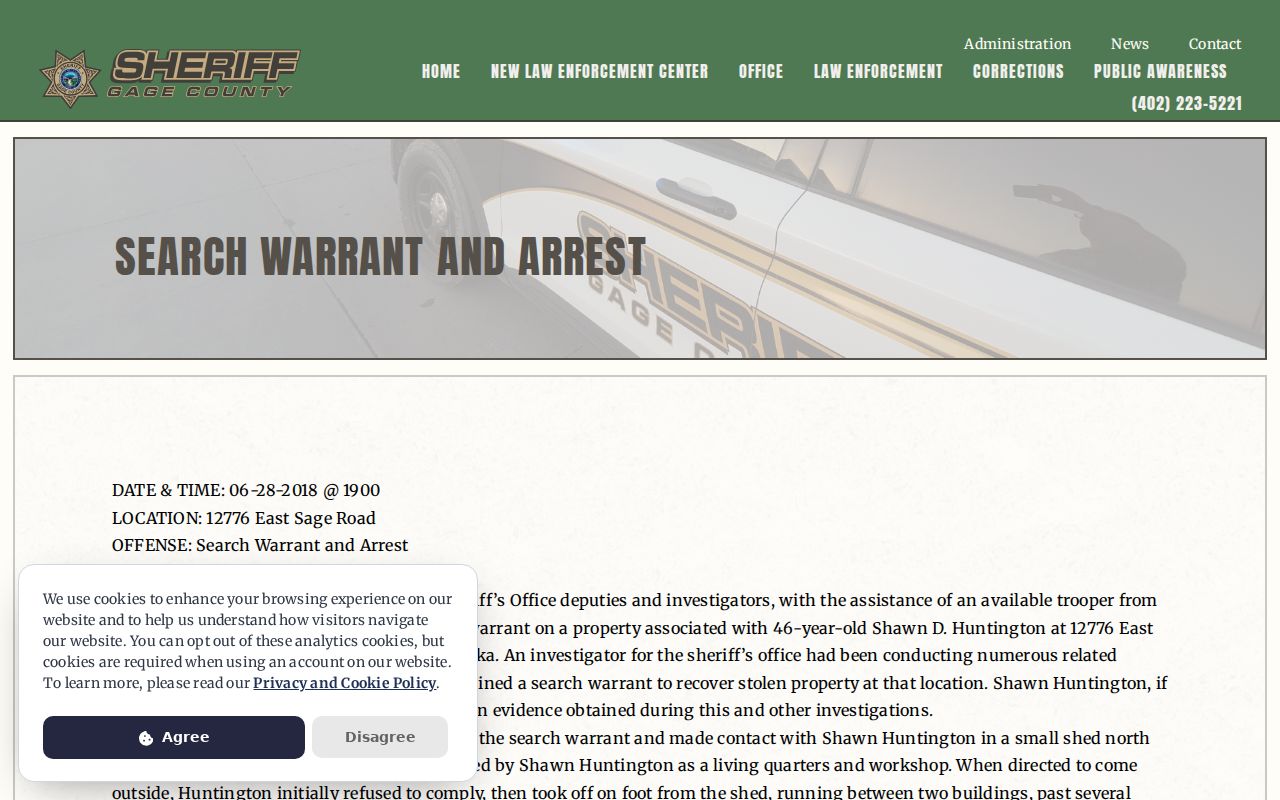
The sheriff's own history of Gage County cases shows investigation, state assistance, warrant service, booking, and detention as separate steps. No private case appears there.
What an Arrest Warrant Contains
The court record often runs deeper than a public card. Ask the Gage County clerk for the actual process document or register event by case number. Then ask about current status and release instructions. The sheriff's list cannot replace that request.
| Complaint | The written accusation and probable-cause basis described by Nebraska law. |
|---|---|
| Accused and offense | Party and charge information, subject to public-record limits. |
| Issuing court | County Court or District Court, depending on the case stage and jurisdiction. |
| Officer direction | Sheriff, city police, marshal, or other authorized peace officer. |
| Release terms | Bond, recognizance, or other court instruction, not shown on the sheriff card. |
| Return | Officer's report after service, addressed by §29-412. |
The Gage Complaint and Magistrate Review
Nobody can rebuild probable cause from a Gage County list card. A card may name a charge. It leaves out the complaint, the affidavit, the judge, and the court. A focused court-record request can ask for one specified public document, though investigative material, sealed files, and juvenile records may be withheld. The clerk can explain what exists. Two courts split the work. Gage County Court, 612 Grant Street, Room 17, (402) 223-1323, handles traffic, ordinance, misdemeanor, and preliminary-hearing matters. The District Clerk, Room 11, (402) 223-1332, holds district felony records. Start with the court named by JUSTICE or by the sheriff.
How Gage County Arrest Warrants Are Served
Service rests on two Nebraska statutes. §28-927 states an officer's duty to serve a warrant when the officer can execute it. Section 29-406 lets the warrant run to the sheriff, a city or village marshal, or a police officer. In Gage County, the sheriff's agency key may show BPD, WPD, NSP, GP, or GCSO. That label is not a status field.
- The court issues process after the required review.
- The directed agency receives or locates it.
- The officer attempts service and takes the person before the proper magistrate after an arrest.
- The court decides release, bond, or the next setting.
- The court or sheriff confirms what the public list will show later.
Gage Agencies on the Arrest-Warrant Chain
The Gage County Sheriff's Office sits at 612 Lincoln Street in Beatrice, (402) 223-5221. Beatrice Police is at 201 N. 5th Street, (402) 223-4080. Wymore Police shows up in the sheriff's key, though official city records say coverage there has shifted over time. Nebraska State Patrol and Game and Parks also appear. Civil Process is separate from criminal-warrant service. The sheriff says its civilian process server does not serve criminal writs.
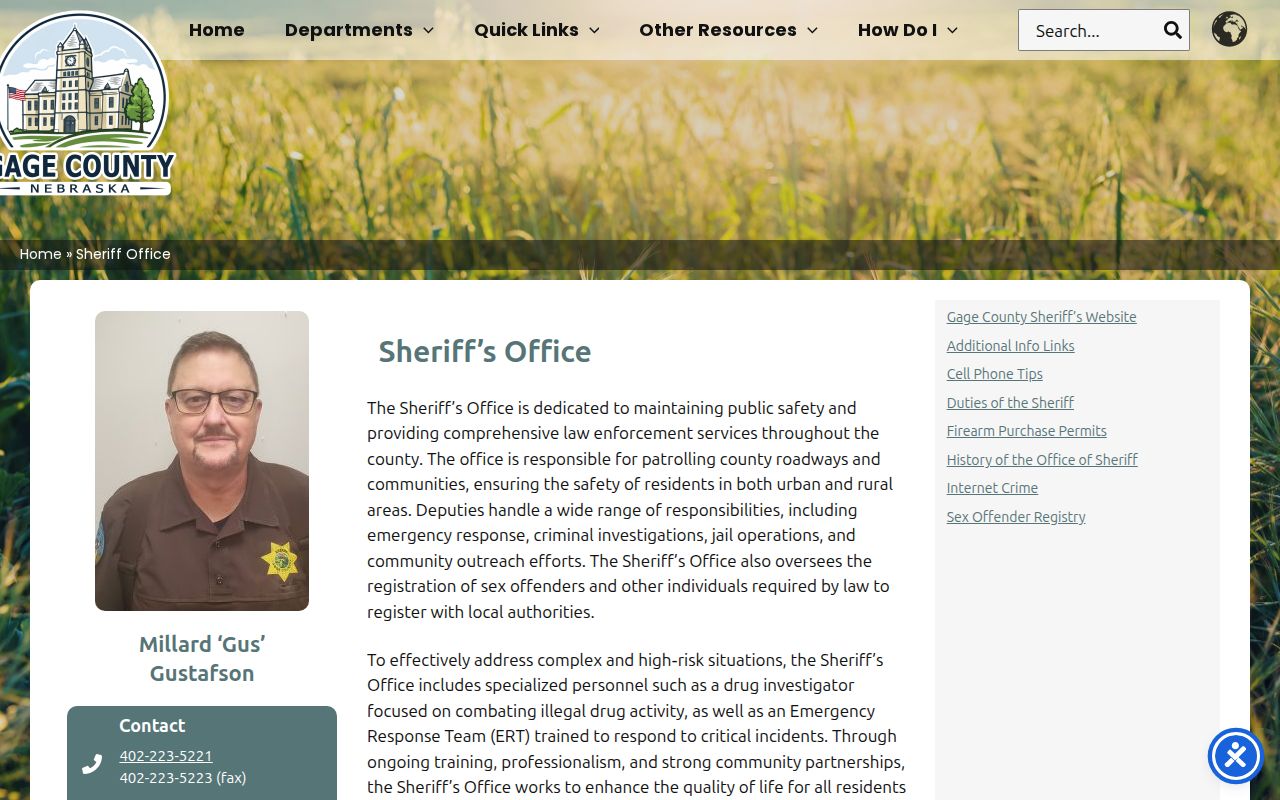
For a Gage County warrant question, the sheriff is the practical first call. The issuing clerk remains the court-record source.
The sheriff's jail-history source gives custody context without promising a warrant intake schedule.
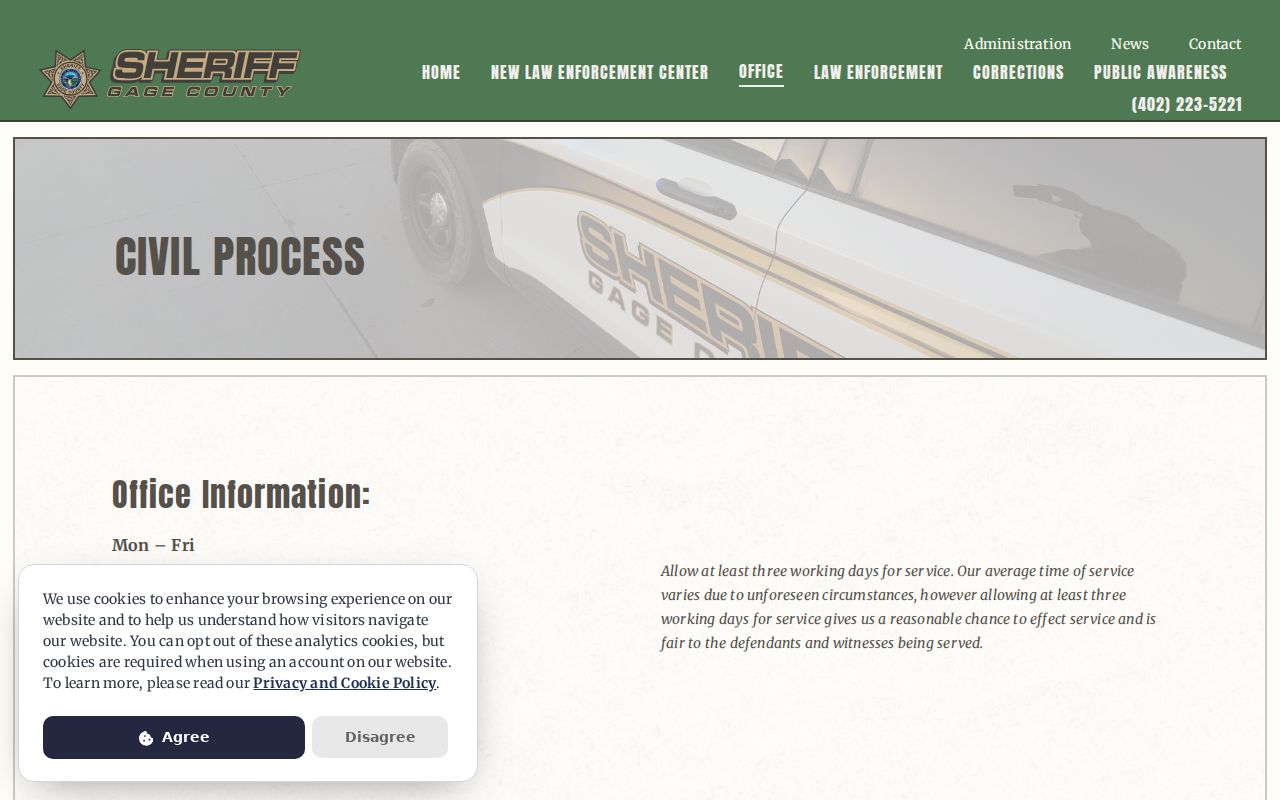
The civil-process source explains service hours and why civil service is not criminal-warrant intake.
Arrest Warrant, Summons, or Bench Warrant?
These terms mark different starts, though the Gage County list may not separate them. An arrest warrant follows a probable-cause complaint. A summons asks the person to appear without the same arrest command, while a bench warrant usually follows a missed court obligation. Ask the issuing court for the exact instrument.
| Process | Typical starting point | Local confirmation |
|---|---|---|
| Arrest warrant | Complaint and probable cause | Sheriff and issuing court |
| Summons | Order to appear | Court clerk |
| Bench warrant | Missed date or noncompliance | County Court or District Clerk |
| Public card | Limited agency and charge display | Never assume it supplies the whole file |
Reading a Gage Arrest Card Against the Court File
A Gage County card shows name, photo area, race and sex, DOB, agency, and charge. What it leaves out matters more. No warrant number, cause number, issue date, court, judge, bond, service date, or cleared status appears. Use those gaps to shape your call. Ask for the case number and issuing court. Then request the court's current register event or instruction. Nebraska JUSTICE helps with public case information, but its one-time search carries a 24-hour lag, a $17 fee, and a 30-record limit. It can name the case. Active service stays a question for the Gage County sheriff. Sealed, juvenile, and investigative records may stay closed.
What to Do If There Is a Gage County Warrant
Call the Gage County sheriff before making a trip. Ask whether the record is yours, which agency is attached, and which court issued it. Then ask what the court expects. It may want a motion, a scheduled appearance, bond, or a walk-through. No general surrender hours are published. If an attorney represents the person, counsel can ask the court about recall, quash, or a new setting.
Verify every payment demand. The sheriff's 2026 warning described spoofed caller ID and kiosk pressure. Use the official sheriff number or court number found independently. GovPayNow is linked for certain payments, but its use does not by itself prove that an arrest warrant is closed.
After the court action, ask the clerk and sheriff how to confirm the change.
Gage Bond and Pre-Arrest Resolution
Nebraska §29-901 and §29-901.01 set the state rules on recognizance and the factors courts weigh for bond, and §29-901.05 covers county misdemeanor bail schedules. For Gage County, the sheriff's bond page links to GovPayNow and warns that a service fee applies. What it does not publish is a single Gage bond amount. No bond type or traffic-warrant payment form appears there either. The current order comes from the issuing court. Ask the court directly, because posting bond does not dismiss the case behind it. One payment may cover a single obligation while a court date still stands. Confirm with the issuing court whether the order changes the warrant status, when the person must appear, and which office verifies clearance.